
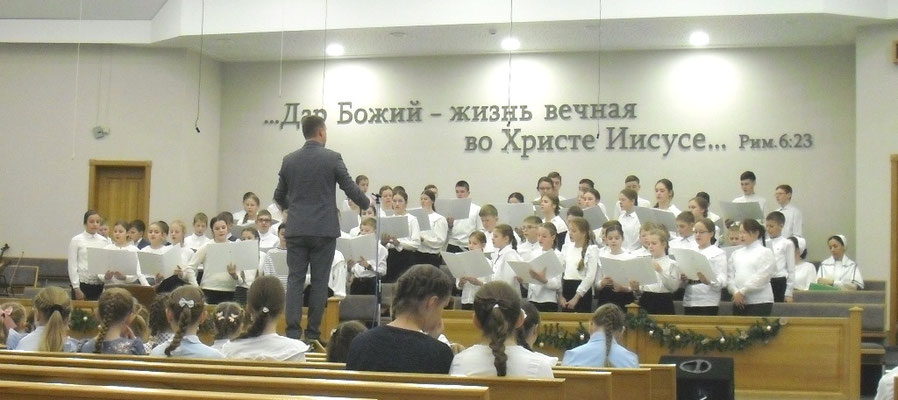
A children's choir during an evening service in Apollonovka. (The verse in the background is from Romans
6:23.)
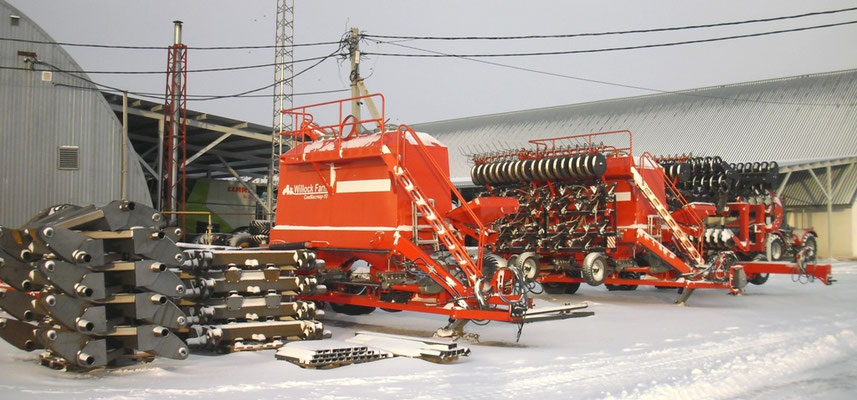
New equipement on the grounds of Sevmaster (Willock Farm) in Medvezhe. Both photos from W. Yoder, Dec. 2025.
Bilingual Farming in Siberia
Commentary
L a d u s h k i n -- Siberia’s farmers had a rough autumn in 2025. An over-abundant harvest kept prices down and transport issues limited the number of available markets. The entire harvest often could not be sold and a significant number of the region’s farmers lost money. David Epp, the technical chief of “Willock Farm”, stated in December that it was the industrial, farm implement branch of his firm which kept the operation afloat. Yet “remaining afloat” is an understatement: The last of five new construction halls is nearing completion and “Sevmaster”, the industrial branch of Willock Farm, is running out of space at its factory site in Medvezhe. That village is located 18 km west of Apollonovka and 165 km west of the million-plus city of Omsk. Apollonovka is one of Russia’s few majority-Protestant villages, peopled largely by ethnic Mennonites who had arrived from today’s Ukraine at the turn of the 20th century.
On the production floor in Medvezhe, dealings are heavily bi-lingual. Willock Farm is surely the largest firm in all of Russia doing much of its production work in Plattdeutsch, a Low-German dialect used globally by ethnic Mennonites of north German ancestry. Roughly 50 of Willock Farm’s 60 employees are of German ethnicity.
This project’s honoured patriarch, the Mennonite farmer Walter Willms from Abbotsford in British Columbia, still visits Apollonovka annually. He jump-started the project in 2002 with an interest-free, now repaid loan. (There’s more history on Willock’s Russian-language website: “willock-farm.ru”. See also: “www.wyoder.de/english-home/-/mennos-anywhere”.)
Wealth remains on the upswing: Heinrich Schellenberg, an ethnic-Mennonite veterinarian and lay pastor in Neudachino east of Omsk, assured that he and his family have no reason for an exit to Germany. “We have work, money, housing, the church, family and friends. There is nothing more that we could need.”
Visits to and from Germany still occur on roughly a weekly basis. Since there are no direct flights from Germany, travellers must fly to or from Germany via Kazakhstan or Turkey. The area’s proximity to Kazakhstan makes the circumventing of Western sanctions unproblematic. At Willock Farm, an impressive line of German-made Claas combines remains in operation.
Mission
Apollonovka may not be a melting pot, but it’s cultural diversity is increasing. Though it houses only 1.000 residents, the world is knocking at Apollonovka’s door. Though the village is approximately 80% Mennonite/Baptist, it now features both an Orthodox chapel and a mosque. The latter is intended for recent arrivals from neighbouring Kazakhstan. Apollonovka’s Baptist, recently-built “house of prayer” seats 900. While wishing to retain its distinctive culture, the congregation is actively engaged in mission work in the villages of Znamensk region, 370 km northeast of Apollonovka. Russian Baptists and Pentecostals also have by now a long history of rehabilitation work among those suffering from substance abuse.
We middle-class Westerners are often shocked by the seemingly narrow, very conservative theology expressed by the rural Mennonites and Baptists of Russia. Yet if one relies on the numbers, the essentially liberal, once-evangelical circles of the political West are on the road to extinction. But survival requires more than high fertility rates: No less important is the willingness of offspring to continue the beliefs and traditions of their parents.
A lay pastor north of the border town of Isilkul reports that all of his seven adult children are now living in their hometown. Yet his model may be combining excessive security with insufficient freedom. As with everywhere else, Western Siberia has not yet discovered the ideal formula for balancing security with freedom. But these Christian communities have at least – in contrast to the traditional church communities of Western Europe – retained sustainability. They have survived a westward-bound brain drain with exit rates as high as 80-90% and are growing once again. That feat remains unmatched among the evangelicals of Western Europe.
Relations with the state
Since the outbreak of major hostilities in early 2022, the Baptists and Mennonites of Western Siberia have successfully achieved exemptions from military service for their young men. Sometimes grudgingly, draft boards continue to concede that Article 59 of the Russian Constitution permits exemption from military service for reasons of conscience.
Yet this pacifism should not be misunderstood as opposition to the existing state. One is reminded that the hospital train staffs of World War I, heavily populated by Mennonites, were not skimpy in their praise of the Russian Czar. Siberian Baptists are relieved that the current war is far away, but deaths among non-German neighbours, even in Apollonovka, has brought the conflict home.
We from the West’s alternative scene “schooled” in the world of politics tend to locate the cause for the Ukraine war in the West´s rejection of Russian security interests. These essentially non-intellectual Siberian believers restrict themselves to the religious realm, attributing the cause of the war to the general, fallen nature of humankind.
Not all wounds inflicted during the Soviet era have healed and not all suspicions have died. Among the ethnic Germans west of Omsk, the majority of their men grew up without fathers or grandfathers; their last death in a Gulag occurred in 1985. But the rehabilitation of Alexander Solzhenitsyn in 1990 and the offering of subsidies are signs of state willingness to make amends. Though the government has often offered them credits, these evangelicals try and do without. But subsidies for children and residential construction are readily accepted.
The Siberian authorities do have very material reasons for making amends. Despite its small workforce, Willock Farm has become a vital force contributing to the survival and growth of Western Siberia’s “outback”. Though technically illegal, a clear modus vivendi has been in force since the coming of Gorbachev. The “Omsk Brotherhood”, which was formed in 1960 among the largely ethnic-German Baptists and Mennonites of Western Siberia, remains a significant unregistered force alongside the 1961-founded "International Union of Churches of Evangelical Christians-Baptists" (IUCECB). The major church building in Apollonovka is registered as a privately-owned structure “reserved for religious usage”.
Class differences
Since first visiting Apollonovka in 2018, I have asked whether the uneven distribution of wealth could lead to a repeat of the catastrophic East-Ukrainian raids by anarchists and communists of a century ago. A vital difference is that these ethnic Germans are now renting farmland from local Russian villagers and thereby including them in on the profits reaped by Willock Farm. Renting more land than they own makes these farmers, at least formally, distinct from the despised “kulaks” of yore.
But there is also another factor which could help insulate them from a repeat of the 1920’s. Orania, an extremely-contoversial, all-white Calvinist, Afrikaaner community in the badlands of South Africa, places great value in doing its own physical labour. The community warns on Youtube that it would promote the return of the failed Apartheid system by paying the poor to do the dirty work. The group sees cleaning its toilets themselves as one way to limit the class animosity of former times. Simply paying the poor for rudimentary work encourages dependency, not development.
In Apollonovka, the ethnic Germans have invested their own sweat, tears and considerable cash to solve the entire village’s drainage issues. Despite spanking-new offices in Medvezhe, the Apollonovka community continues doing its own manual work without graduating to an office desk and passing on the dirty work to hired hands. Senior Pastor Ivan Wall remains an electrician. Retirees still raise livestock in their backyards in order to improve their meagre pensions.
Orania envisions a successful South Africa as a collection of independent, economically-succesful communities. Their own economic success is intended to encourage neighbouring black communities to “go and do likewise”. In Apollonovka, non-Caucasians and ethnic Russians are highly welcome at church services and many of its members would be appalled to be likened to a South African model. But similarities remain. Self-governing communities working in harmony with one another is not far removed from the model envisioned in Siberia. Orania claims that its separation is based on culture, not on race. But there are very few or no Afrikaaner who happen to be black and Calvinist in faith.
The future
Russia finds itself deep within the throes of reorientation. The nation is turning its face eastward and southward. But Russia’s Protestants, along with Russia’s intellectual elite, remain westward in orientation. Understandably, the ethnic-Germans of Western Siberia remain unwilling to break that connection: After all, the majority of their relatives reside in Germany. The situation is not unlike the divided families in the two German states after 1945.
The ethnic-German farmers of Western Siberia do little trade with China, yet that remains a promise for the future. It will take modern roads and the destruction of bureaucratic hurdles to get this trade moving.
Massive, once state-run collective farms (kolkhoz) in both Apollonovka and Neudachino are lying in ruins. The three-part Apollonovka kolkhoz sits on 11.000 hectares (27.170 acres) of unused land, more than twice the size of Willock Farm. It will take a voice from high above, or an extremely astute lawyer, to split the bureaucratic knot. There are those on the American continents who believe the Mennonite farmers of Latin America have the wherewithal to transform these ruins into a land of bounty.
William Yoder, Ph.D.
Ladushkin, Kaliningrad region, 22 January 2026
A journalistic release for which only the author is responsible. It is informational in character and does not express the official position of any church organisation. This release may be reprinted free-of-charge if the source is cited. Release #26-01, 1.522 words.
